
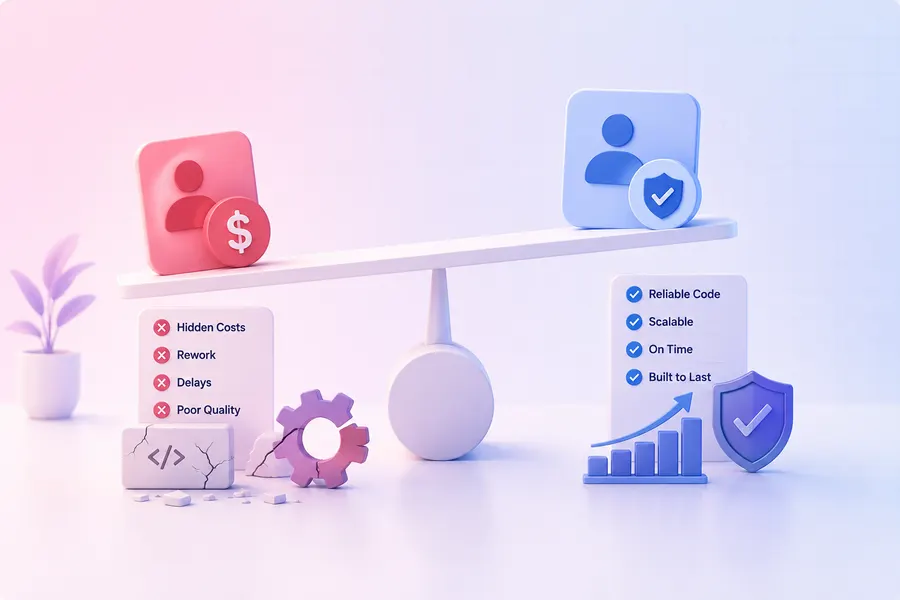
A startup founder we spoke with had an excellent product idea and real early traction. What she didn't have was a system she could confidently put in front of customers. She had built her MVP with a low-cost development team, watched the price tag stay small, and only discovered the real cost months later — once she tried to scale.
The idea was never the problem
This is a pattern we see constantly with early-stage founders, and it rarely has anything to do with the quality of the idea. A founder validates a concept, moves fast to keep costs down, and hires the cheapest capable team they can find to get a first version built. That's a reasonable instinct — capital is scarce and speed matters. The problem isn't the decision to move fast. It's that "cheap" and "fast" quietly became a substitute for "built to last," and nobody flagged the trade-off at the time it was made.
By the time she realized the system's foundation couldn't support what she needed — reliability, scale, and the kind of technical trust that gets a product past early adopters — she had already spent months and a meaningful budget on something she couldn't confidently build on.
What a weak foundation actually looks like
Inconsistent backend behavior
Features that worked in a demo failed intermittently in real use — the kind of instability that erodes user and investor trust fast.
No deployment discipline
Changes went out without a real CI/CD process, making every update a small gamble instead of a routine event.
A data architecture chosen for speed, not scale
Early storage decisions that were fine for a prototype became a structural bottleneck the moment real usage started.
No one who could explain why
When something broke, there was no clear owner who understood the system well enough to diagnose it quickly — every issue took longer than it should have.
Cheap isn't the opposite of expensive — it's the opposite of durable
The real lesson here isn't "never hire affordable talent." Plenty of low-cost teams do excellent work. The lesson is that price and value are not the same axis, and founders under pressure to conserve runway often collapse the two without meaning to. A cheaper build that has to be substantially redone six months later was never actually the cheaper option — it just deferred the real cost to a point where it's more expensive to fix and more painful to discover.
What to do about it
-
Audit what exists before rebuilding anything
Not every part of an early system is broken. The goal is to identify what's structurally sound versus what needs to be replaced — not to throw out working code out of frustration.
-
Bring in fractional expertise before committing to a full rebuild
A senior technical review can often diagnose the real bottleneck — architecture, data model, deployment process — without the cost of a full engagement.
-
Stabilize before you scale
Fixing reliability and structural issues has to come before adding new features or pushing for growth — growth on an unstable foundation just surfaces the same problems faster and more publicly.
-
Plan the next build to survive success
The system has to be designed for the scale the founder is aiming for, not just the scale it happens to be at today.
Inherited a system you're not sure you can trust?
If you're a founder wondering whether your current system can actually support where you're trying to take the business, we can help you get a clear, honest answer — before you spend more money finding out the hard way. Talk to the TLS team.