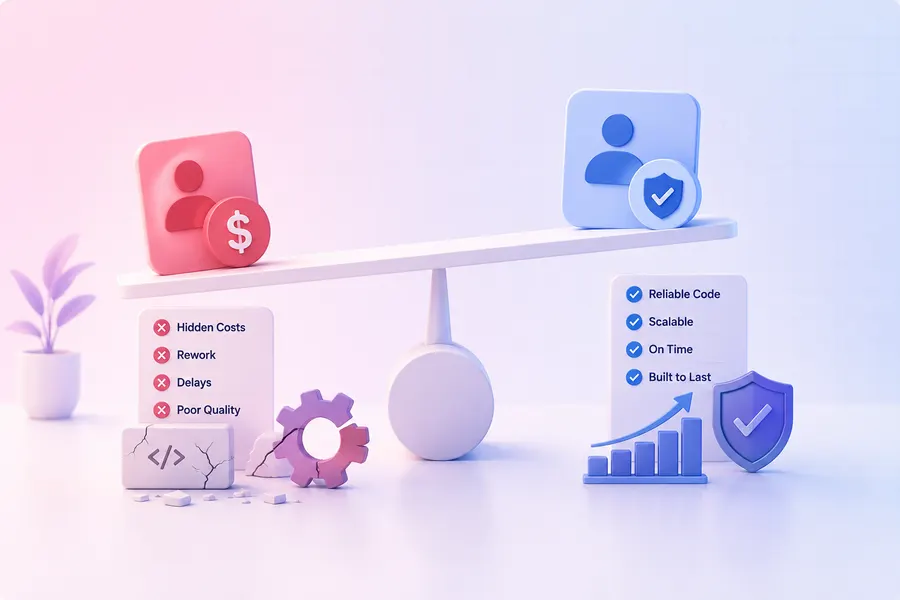
There is a version of every software project that gets delivered on time, within budget, and technically does what it was supposed to do. The team celebrates. The project is closed. Six months later, the business is complaining that the system is slow, hard to use, or missing half the functionality they actually needed.
This is "the good enough trap." And it costs far more than anyone accounts for upfront.
What "good enough" looks like in production
We have debugged and stabilized production systems where mapping errors in a 401(k) processing pipeline were causing incorrect financial outputs downstream. The original build worked — technically. But it was not built with enough defensiveness against the edge cases that payroll data actually throws at you: nullable fields, inconsistent CSV formats from different vendors, column ordering that changes without notice.
When those edge cases hit production, the cost was not just rework. It was reconciliation errors, trust loss, and weeks of firefighting that nobody budgeted for.
Where the real cost accumulates
Unhandled edge cases
Nullable fields, format inconsistencies, and unexpected input variations that may pass QA but fail in production.
Firefighting overhead
Engineers pulled away from new work to investigate incidents that a more defensive architecture would have prevented.
Downstream data quality
Bad data produced by a fragile system propagates into reporting, reconciliation, and business decisions.
Unmaintainable codebase
Systems built for speed without structure that the next engineer cannot safely modify or extend.
How we build instead
-
Design for real-world conditions
We build for what the system will actually face — not just what the requirements document describes.
-
Handle edge cases before they are incidents
Defensive error handling, validation layers, and null-safe logic are designed in from the start.
-
Build for maintainability
Clean architectural separation so the team that inherits the codebase can understand, debug, and extend it safely.
-
Quality as the baseline
We treat quality as the minimum standard — not an optional layer added at the end of delivery.
Build software that holds up where it matters
If you are evaluating a new build or inheriting a system that is underperforming, we would like to help.