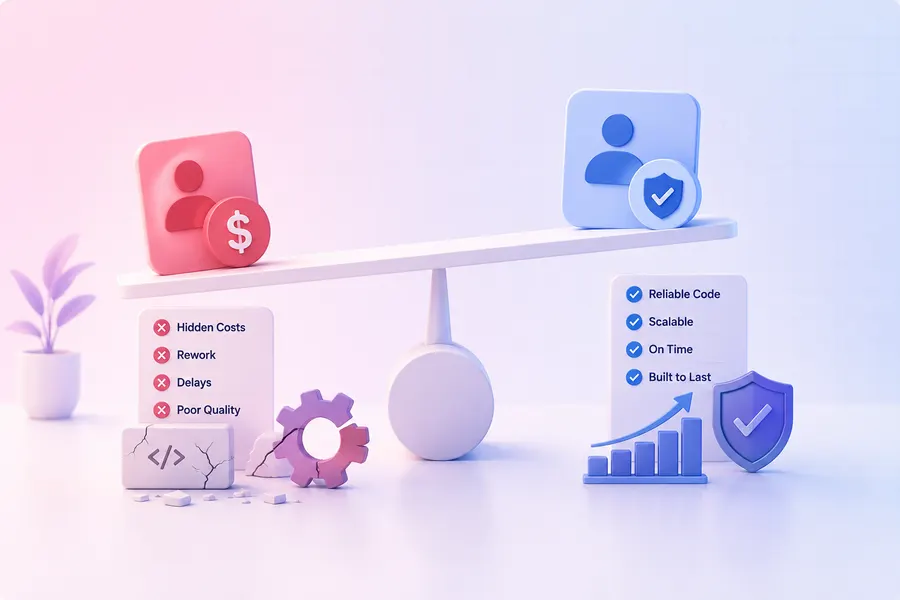
Off-the-shelf ERP platforms sell a promise: implement our system and inherit years of best practices for free. For a lot of businesses, that promise holds. For businesses whose core operations do not map cleanly onto a generic workflow, it does not — and the cost of forcing the fit is usually higher than the cost of building something that actually matches how the business runs.
Where off-the-shelf starts to break down
The pattern shows up the same way almost every time: a business licenses a platform, spends months configuring and customizing it to approximate their actual process, and ends up maintaining a fragile layer of workarounds on top of a system that was never designed for their workflow in the first place. At that point, the platform is not saving effort — it is taxing it.
Full control over the workflow
The system is built around how the business actually operates, not the other way around — no configuring around a vendor's assumptions.
No licensing bloat
Per-seat or per-module licensing costs that scale with headcount disappear; you pay for what you build and maintain, not for unused platform breadth.
Tailored integrations from day one
Custom builds are designed to talk to your actual systems — no middleware layer working around a platform's rigid integration model.
Ownership of the data model
The data structure reflects your business logic, not a vendor's generic schema — which matters enormously once you start building reporting or automation on top of it.
When custom actually makes sense
-
Your core workflow doesn't map to standard modules
If you are spending more time customizing than configuring, that is a signal the platform was the wrong starting point.
-
Licensing costs scale worse than build costs
Per-seat and per-module pricing can outpace the cost of a custom build faster than most teams initially estimate.
-
Integration needs are extensive
If the ERP needs to talk to five or six other systems in ways the vendor didn't anticipate, custom integration work is happening either way — the question is what you're integrating with.
-
You need long-term ownership of the roadmap
A custom system's roadmap is yours to set. A platform's roadmap is the vendor's — and you inherit their priorities, not yours.
Weighing custom vs. off-the-shelf?
We help teams figure out honestly which side of that line they're on — before committing budget to either path. Talk to the TLS team.