Enterprise financial systems integration is one of those projects that gets underestimated in almost every organization that attempts it. The pitch is straightforward: connect System A to System B, automate the data transfer, eliminate manual work. The reality is considerably more involved.
We have built integration layers between payroll and HCM platforms, between CRM and ERP systems, and between custom applications and enterprise financial databases. Across all of them, the most dangerous assumption is that the two systems speak the same language. They almost never do.
The three layers of complexity
-
Field-level mismatches
A string in one system is an integer in another. Dates formatted differently. Required fields that are nullable in the source. Every mismatch needs explicit handling — not just a type cast.
-
Pagination and authentication at scale
Most enterprise APIs are rate-limited and require token refresh cycles. An integration that works in testing against small data sets behaves differently processing thousands of records against a production endpoint.
-
Failure handling and observability
What is the retry strategy? How does the system communicate failures? Where does the engineer go when a record fails to sync and nobody noticed for three days?
What this looks like in production
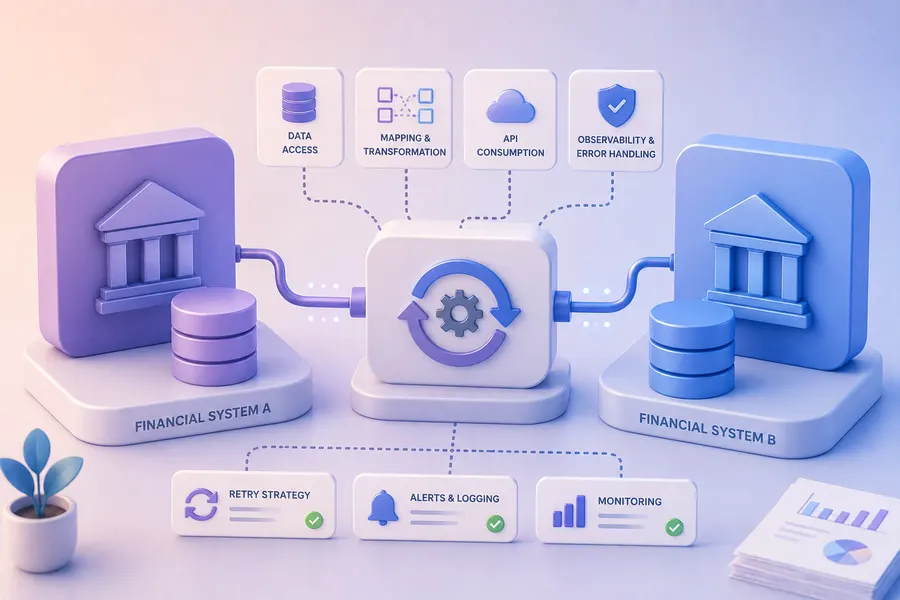
These are not edge cases. They are the normal operating conditions of a production integration. When we built the payroll and HCM integration between two enterprise platforms, we designed clean architectural separation between data access, mapping, transformation, and API consumption layers from the start. That structure is what made the system debuggable when vendor file formats changed and extensible when new data sources were added.
How we build integration systems
Layered architecture
Data access, mapping, transformation, and API consumption separated into distinct layers — so each can be debugged, tested, and extended independently.
Defensive field mapping
Every field mapping accounts for nullability, type mismatches, and format variations. Edge cases handled before they become incidents.
Failure-first design
Retry strategies, error logging, and observability designed in from day one — not added when the first production incident forces it.
Built for change
Vendor schemas change. APIs update. The architecture accounts for this so the system does not require a rewrite every time upstream changes.
Planning a financial systems integration?
If you are planning a new integration or inheriting one that is underperforming, let us talk.